How to Prepare for Video Transfer Success
“Super 8″ Movie Write-Up in Boston Globe
James Sullivan, Boston Globe’s Correspondent’s article on Steven Spielberg’s new Super 8 Movie that just came out on DVD talked about the Super 8 film transfer business and included a very nice write-up of Play it Again Video in Newton, MA
Here’s an excerpt of his article. You can find the full article here:
http://articles.boston.com/2011-11-27/news/30447866_1_film-footage-dvd-transfers
In “Super 8,’’ just out on DVD, some young teenagers become embroiled in an extraterrestrial mystery while filming their own low-budget zombie movie. The year is 1979.
It turned out to be a pivotal time for the format that gave the movie its name. Introduced in the 1960s as a user-friendly variation on the older 8mm film, Super 8 was quickly embraced by home-movie buffs. But its popularity was fleeting; by the early ’80s, it was already being pushed aside by the emergence of videocassettes. Yet Super 8 film, like movies about E.T.s and zombies, has retained a certain appeal. There are far fewer film labs working with old small-gauge film stock such as Super 8 than there were three decades ago. But those that remain still do considerable business with filmmakers, art students, and walk-ins from the general public who have uncovered troves of family footage. Click here for the full article.
View 8mm film Before Transferring to DVD
A woman came in with 6 5-inch 8mm film reels she found in her deceased father’s attic. The reels were not labelled so she had no idea what was on it. She hopes it’s home movies, but what if it’s a football game or hours of her dad fishing? Is it worth the money to transfer the film?
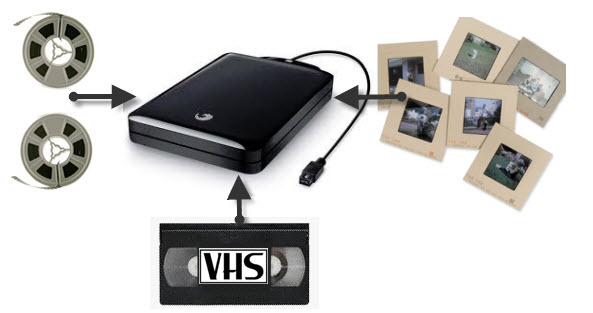
No need to guess. Call us to reserve a viewing station. Come in with your 8mm, Super 8, 16mm film to view them BEFORE you decide which film reels to transfer. All you need to do is to reserve an appointment, come in at your scheduled time with your VHS tapes, film reels, audio cassettes or whatever old media you wish to view.
Old Media you can bring to view:
- VHS Tapes, VCR, VHS-C (the compact tape that fits into a cartridge)
- We have the VHS-C cartridge, no need to turn the attic upside down looking for yours
- 8mm Tapes, Sony Hi8
- miniDV Tapes
- Film Reels: 8mm, Super 8, 16mm film reels
- Audio: Cassettes, LP (Vinyl records) – all speed
- Slides: 35mm slides – line them up in our slide viewer for easy viewing.
See you at the store. We’ve reserved equipment for you to step back into the 60′s, 50′s. We can even play some Big Band music while you are watching and reminiscing. There is no obligation to transfer your tapes, film or slides.

Super 8 the Movie
Steven Spielberg’s latest: Super 8 is now in theaters. The story starts with a group of kids who wanted to make a zombie movie with a Super 8 camera.
While shooting, by chance, they witnessed a dramatic train crash. Since then, strange occurrences and events happen in their town, the army shows up and appear to be hiding a secret that will change their lives forever.
The movie is co-produced by JJ. Adams and Steven Speilberg. You’ll be transported to the Speilberg eighties productions, a mix between “ET”, “The Goonies” and a touch of “Jurassic Park”. Even the music, created by Oscar-winning composer Michael Giacchino, is reminiscent of past Spielberg’s films and the composer John Williams. Super 8 has received delightful ratings from critics so far.
It’s amusing that Steven Spielberg has named the movie Super 8, a film video format that disappeared before most of the movie viewers were born.
By the way, if you are still hanging on the Super 8 film, Regular 8, or even the predecessor: 16mm film, you can transfer them to DVD or to a portable hard drive (for editing) at our Newton, MA lab. We have been transferring 8mm film to DVD since 1986. Wait, that’s a lie. When we started in 1986, we were transferring 8mm film to VHS tapes, only in the 90′s did we start transferring film to DVD. And those VHSs are making their way back to be re-transferred to DVDs.
And if you want to watch more sneak previews of the Super 8 movie, the official website is: Super8-Movie.com
Play it Again Sam
“Hello, is this Play it Again Sam?”
Well, not quite. We’re not really Play it Again Sam. We are Play it Again Video, a film and video to DVD transfer lab in Newton, MA.
But for many of the thousands of customers who’ve come through our doors since 1986, they remember us as “Play it Again Sam”.
It’s not too remote a connection, though. Just like Ingrid Bergman requests Sam to, “Play it Again” and bring back the sweet memories, our beautiful customers bring their films, tapes, slides, photos to our store and ask us to convert them to a DVD they can watch again. Cesare Pavese, Italian poet, says “The richness of life lies in the memories we have forgotten.”
So call us what you like, call us Play it Again Sam, call us Play it Again Video, we know what you mean. More importantly, we know what you want. To relive those memories trapped in your home movies film and tapes – 16mm, 8mm, Super 8, VHS, HI8, miniDV…

Film to DVD – Digital Backup Tape
When you transfer your 8mm, Super8, 16mm film reels to DVD at our on-site Film transfer lab in Newton, along with your original film reel (cleaned and conditioned) and a finished DVD, you also receive a digital backup tape as a standard part of the service.
Q. What is the purpose of the digital backup tape?
A. Insurance. Film transfer is labor intensive, therefore costly. The film has to be cleaned and conditioned – by hand, any sprocket damage or bad splices repaired before the film digitization transfer can even start. It’s common to spend a few hundreds of dollars to transfer a family collection of film. What happens if you put a scratch on the DVD, or break it? You have to spend hundreds of dollars all over again? That’s the purpose of the digital backup tape. If you break, scratch, lose your DVD, you can simply bring the backup tape to us and we can create DVDs from them. Creating DVD from film reels is hundreds of dollars, but creating a DVD from your digital backup tape is only $20 per tape.
Q. Is there any other purpose to the digital backup tape besides saving me money if my DVD breaks?
A. Yes. Once a video is put on DVD, it’s compressed. The digital backup tape, on the other hand, carries the full-resolution, “lossless” digital backup of your video. If one day, you decide to edit your video, or you want to upgrade to Blu-Ray DVDs, you can transfer the full-resolution video from the tape, as opposed to the compressed video on the DVD.
Q. What’s the best way to store the backup tape?
A. Store it in a safe, cool, dry place. One customer stores it in her bank safe. Wherever you store it, position it vertically, like a book, not flat down (see picture below). If you put it flat down, then the film ribbon is standing on its edge, that creates more pressure on one edge of the film than on the top edge of the film. If you position it vertically, like a book, the film lies flat with respect to the surface.

Q. Can I play or watch the backup tape?
A. If you have a mini-DV camcorder, or a mini-DV walkman, you can pop the tape into the player and watch it. If you don’t, just store it safely for one day when you need it. You can simply bring the tape back to our store and we can create a DVD out of the tape for you ($20/tape).
8mm Film to DVD Background Music
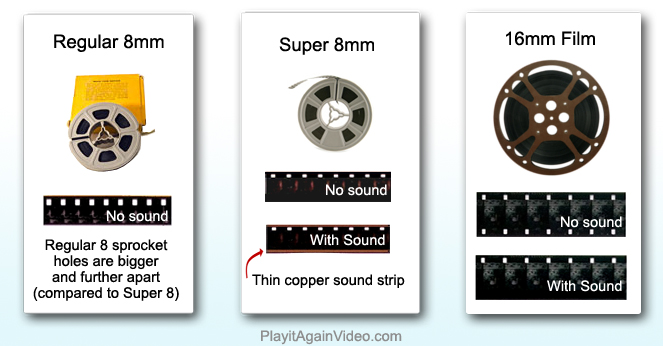
The majority of 16mm, Regular 8, Super 8 film home movies are silent. The latest format, Super 8 film was originally a silent system only, but in 1973 a sound on film version was released. The sound film had a magnetic soundtrack which is visible as a thin copper strip on one edge of the film (see diagram below).

The reason there’s not a lot of Super 8 SOUND film out there is because not very long after Sound-On-Film became available, the VHS came out. The VHS (trivia: VHS: Video Home System) recording and playing standard was launched in the US in June of 1977. If you weren’t an early adopter of Super 8 Sound, you would skip the new sound-on-film recording and move straight to the VHS.
So, if you are transferring 16mm, 8mm, or Super 8 film to DVD, chances are your home movies will be silent. Which is charming in itself. We do, however, offer the option of adding background music to your silent movies at no extra charge. You have a choice of 4 music genres: Easy Listening, Light Classical, 50′s/60′s Rock ‘n Roll, and Big Band. The most popular choice is Easy Listening. When I have some time, I will post a few samples here. If you are transferring the film to DVD for your parents, ask them what kind of music they associate with the period, that’s how we end up adding Big Band music to many film transfer projects.
Whichever genre you decide, do choose something, if you hate it, you can always mute it and you are back where you start. But there’s a good chance you’ll enjoy watching your silent home movies with a soothing, emotion-evoking light music in the background.
If you are converting your film to digital files on a hard drive, we will not add background music because most customers who transfer their home movies – VHS, miniDV, 8mm, Super 8 film to a hard drive (as opposed to a DVD) have the intention of editing the movies – trimming out unwanted sections, putting titles, transitions, and adding your own background music before burning the final edited movie into a DVD.
8mm Film Sample from the ’50s
Most 8mm film reels are around 40-50 years old. This particular reel was about 53 years old. The first thing we do when we receive film reels is to inspect them. Does the film roll out easily or does it stick? We have seen film reels that look like hockey pucks, all stuck together into one solid disc.
Next, we sniff the film for a vinegary odorthat indicates the emulsion has started to break down. Film in such condition will still transfer but you will find a yellowish tint on the resulting transferred video. You will think I am kidding, but it is the truth: Andy, our film transfer lab manager, has had to use a gas mask a few years ago for a very odorous film reel.
We also look at the film for debris and specks. Fortunately, the films are usually stored in a canister or capped so usually we don’t see a lot of dusts that can’t be removed. Cleaning and conditioning the film reel (by hand) with a non-chemical Kodak cleaner is essential to remove any dusts and debris before we feed it into our expensive film transfer projectors.
The owner of this particular reel discovered it in his father’s attic when his father passed away. However, it was in good condition. It wasn’t sticky, not much dust and no signs of mould, and most importantly, not a hint of vinegary odor at all.
When you watch the sample, notice how the quality of the video changes within the one reel. Film shooting in the 50′s required manual adjustment for everything. If your child ran under a tree shade, your camera didn’t automatically adjust from bright sunlight to sudden shadows. Outdoor shots always come out better. However, if you shoot against a bright background, and your subjects happened to be wearing white, it will look unforgivingly whitewashed.
These imperfections amplify with time as the media does have a shelf life. All magnetic media, that includes VHS, VHS-C, miniDV, Super 8 deteriorate with time. The sooner you your films and video tapes are transferred, the better your chance of getting the best transfer possible.
Our client was very pleased with the transfer. His mother was able to go through and identify family members, friends from the past and relive memories from over 50 years ago. The resolution on the DVD is even sharper and more vibrant than this website version.
Unfortunately, not so for the grandchildren of the bride in the film sample below. She must be a beautiful bride, I’m sure, but we’d have to imagine it since the film has degraded so much with time that it’s hard to make out her face. Don’t let your films get to this irreversible state. Do you know when is the best time to digitize your films and videos? Yesterday.
Film to DVD Transfer


Click here for Film to DVD Pricing